Technological evolution has profoundly transformed modern dental medicine, allowing faster, more accurate, comfortable and aesthetic treatments.
Among the technologies that most revolutionized oral rehabilitation, the CAD/CAM system stands out.
Thanks to this technology, it is currently possible to restore teeth with high precision, often in fewer visits and with much more comfort for the patient.
The CAD/CAM system has become one of the greatest references in digital dentistry, being widely used in prosthetic treatments, aesthetic rehabilitation and modern dental medicine.
At Alora Clínic , in Ramada, Odivelas, Lisbon, we use advanced digital technology to provide faster, more comfortable and predictable treatments.
1. What is the CAD/CAM system?
The CAD/CAM system is a digital technology used to design and manufacture dental restorations with high precision.
The acronym CAD stands for:
Computer-Aided Design — computer-aided design.
The acronym CAM stands for:
Computer-Aided Manufacturing — computer-aided manufacturing.
Together, these technologies allow the creation of personalized dental pieces through advanced digital systems.
2. How does the CAD/CAM system work?
The operation of the CAD/CAM system occurs in several digital stages.
First, the tooth is prepared by the dentist.
Then, an intraoral scan is performed, creating highly accurate three-dimensional digital images of the patient's mouth.
These images are processed by CAD software, which allows the new dental structure to be drawn digitally.
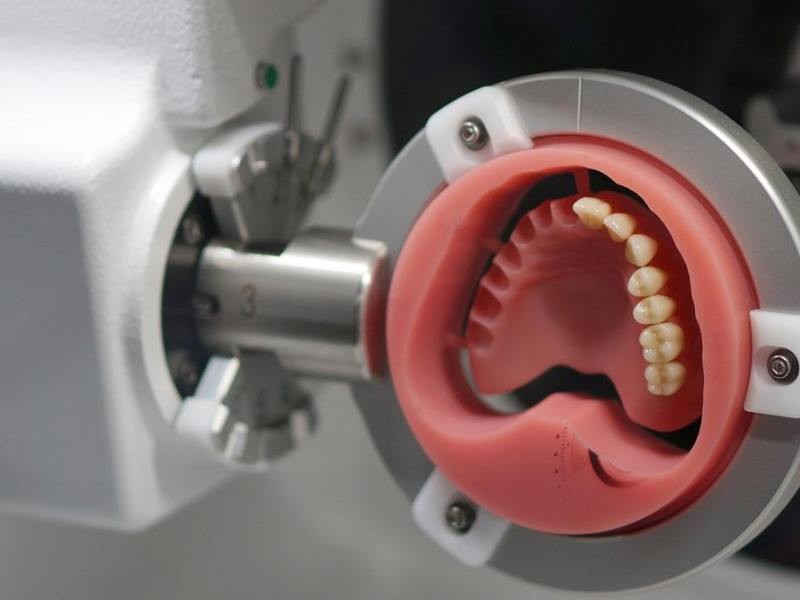
Next, the CAM system comes into action, manufacturing the part through a digital milling machine.
The result is a personalized restoration, produced with high precision and excellent adaptation.
3. What is the CAD/CAM system for in dentistry?
The CAD/CAM system is used in different areas of dentistry.
Among the most common applications are:
- dental crowns;
- facets;
- dental lenses;
- inlays and onlays;
- dentures;
- aesthetic rehabilitation;
- structures on implants.
Technology allows highly personalized and predictable treatments.
4. What are the advantages of the CAD/CAM system?
The CAD/CAM system offers numerous advantages for both patients and professionals.
- greater accuracy;
- more comfort;
- fewer consultations;
- faster treatments;
- excellent adaptation of the pieces;
- natural aesthetic results;
- personalized digital planning;
- less discomfort during treatment.
In addition, many restorations can be performed on the same day, depending on the clinical case.
5. Does the CAD/CAM system replace traditional mouldings?
In many cases, yes.
Digital intraoral scanning often replaces traditional mouldings with masses.
This provides:
- more comfort;
- less nausea;
- faster;
- better accuracy;
- more practicality.
Many patients consider this one of the greatest advantages of digital dentistry.
6. How does intraoral scanning work?
Intraoral scanning is performed using a high-precision digital scanner.
The equipment runs through the teeth and gums, capturing three-dimensional images in real time.
These images allow you to create an extremely detailed digital model of the patient's mouth.
The process is fast, comfortable and highly accurate.
7. Is the CAD/CAM system more accurate?
Sim.
One of the biggest advantages of the CAD/CAM system is precisely the high digital precision.
The software allows:
- enlarged visualization of dental structures;
- thorough adjustments;
- better adaptation of parts;
- highly customized planning.
This significantly improves the final quality of the restaurants.
8. How long does a CAD/CAM treatment take?
Time varies according to the type of treatment and clinical complexity.
However, compared to traditional methods, the CAD/CAM system allows much faster treatments.
In some cases, it is possible to realize:
- scan;
- planning;
- piece production;
- restoration installation.
All in fewer consultations or even on the same day.
9. Is the CAD/CAM system comfortable for the patient?
Yeah, quite a lot.
As much of the work is done digitally, the patient spends less time with the mouth open and avoids many traditional uncomfortable procedures.
In addition, intraoral scanning is much more comfortable than conventional moldings.
10. Are the materials used in CAD/CAM resistant?
Sim.
The restorations produced by the CAD/CAM system are manufactured with highly resistant and aesthetic materials.
Among the most used materials are:
- dental ceramics;
- zirconia;
- high strength resins;
- hybrid materials.
These materials offer excellent durability and natural aesthetics.
11. Does the CAD/CAM system improve the aesthetics of the smile?
Sim.
Digital planning allows to design highly personalized restorations, respecting:
- tooth format;
- facial harmony;
- dental color;
- occlusion;
- smile aesthetics.
This provides more natural and predictable results.
12. Who is the CAD/CAM system suitable for?
The CAD/CAM system can benefit different types of patients.
It is indicated for:
- oral rehabilitation;
- aesthetic treatments;
- dental crowns;
- facets;
- dental implants;
- fixed prostheses;
- extensive restorations.
Clinical evaluation helps define the best approach for each case.
13. Why has the CAD/CAM system revolutionized digital dentistry?
The CAD/CAM system revolutionized digital dentistry because it made treatments:
- faster;
- more precise;
- more comfortable;
- more predictable;
- more personalized.
The integration between digital scanning, virtual planning and computerized manufacturing has profoundly transformed the clinical experience of patients.
14. Where to carry out treatments with CAD/CAM system?
The ideal is to look for a clinic with experience in digital dentistry, scanning intraoral and personalized digital planning.
At Alora Clínic , in Ramada, Odivelas, Lisbon, we use advanced CAD/CAM technology to provide more modern, fast and comfortable treatments.
15. Conclusion
The CAD/CAM system represents one of the greatest evolutions of modern digital dentistry.
Thanks to digital technology, it has become possible to perform dental restorations with high precision, speed and comfort.
Intraoral scanning, digital planning and computerized manufacturing have revolutionized the patient experience, reducing discomfort and significantly improving clinical and aesthetic outcomes.
At Alora Clínic , in Ramada, Odivelas, Lisbon, we offer advanced digital treatments with modern technology and personalized monitoring.
If you want to know more about the CAD/CAM system or make a personalized evaluation, you can schedule a consultation with our team.