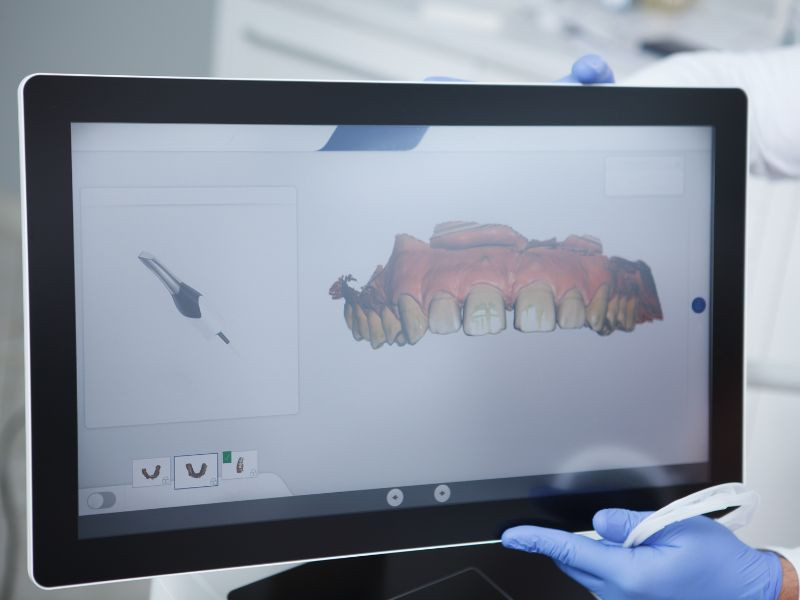
Technology has transformed dentistry, making diagnoses and treatments increasingly accurate, fast and comfortable. One of the equipment that contributed to this evolution is the intraoral scanner .
But after all, how does the intraoral scanner work? What is it for? Does it replace traditional moldagens? And what is its importance in the planning of treatments with aligners? In this article, we will explain in a simple way how this technology works and what are its main advantages.
Ready to know more about the intraoral scanner? So let's go!
What is an intraoral scanner?
The intraoral scanner is a digital device used to capture detailed images of the inside of the mouth.
Through a small camera, the professional manages to obtain a three-dimensional representation of the teeth and oral structures, allowing to work with a digital model of the patient's mouth.
How does the intraoral scanner work?
During the procedure, the dentist carefully moves the scanner inside the mouth. The equipment captures hundreds or thousands of images that are then combined by software to create a three-dimensional model.
The entire process is done digitally, allowing you to visualize the teeth in great detail.
Does the intraoral scanner replace traditional mouldings?
In many treatments, the intraoral scanner can replace conventional casts made with printing materials.
For many patients, this is an important advantage, as it eliminates or reduces that uncomfortable feeling associated with the use of molds and molding materials.
Is the intraoral scanner uncomfortable?
In general, the procedure is quick and comfortable. The scanner is inserted into the mouth and passes through the different areas of the dental arch to capture the necessary images.
Because it does not use molding materials, it can be a particularly comfortable alternative for people with more sensitive vomiting reflex.
What is the intraoral scanner for?
The intraoral scanner can be used in different areas of dental medicine. Among its applications are:
- Orthodontic treatment planning;
- Planning with aligners;
- Evaluation of the position of the teeth;
- Planning of restorations;
- Digital recordings of the mouth;
- Follow-up of the evolution of certain treatments.
What is the importance of the intraoral scanner in the treatment with aligners?
In the treatment with aligners, the scanner allows to obtain an accurate digital model of the patient's dentition.
This model can be used in the planning of dental movements and in the creation of a personalized sequence of aligners, allowing to digitally visualize different stages of the treatment.
Does the intraoral scanner allow you to see the final result before the treatment?
Digital planning technology can allow the patient to visualize a simulation of the expected evolution of the treatment.
It is important to understand that this representation is a forecast based on planning and not an absolute guarantee of the final result, since each organism responds individually to treatment.
What are the advantages of the intraoral scanner?
Among the main advantages are greater comfort, speed, digital viewing and ease of storage and sharing of records.
The technology also allows to integrate different digital tools in diagnosis and planning, contributing to a more personalized approach.
Conclusion
The intraoral scanner represents an important evolution in digital dentistry. By allowing three-dimensional models of the mouth to be created quickly and comfortably, this technology facilitates the diagnosis and planning of various treatments.
In the case of aligners, the intraoral scanner can play an important role in creating a personalized plan and visualizing the expected evolution of the smile.
Do you want to know the possibilities of digital planning for your smile?
At Alora Clínic, we bet on technology and personalized monitoring to provide a modern and comfortable treatment experience. Schedule an evaluation and find out how the intraoral scanner can be part of your treatment planning.
Mark Your Consultation