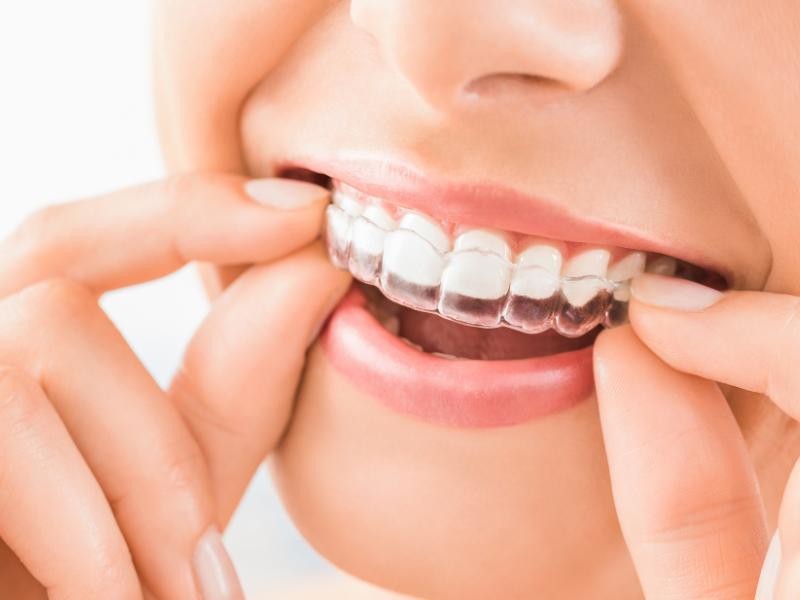
The invisible aligners revolutionized modern orthodontics, making dental alignment more discreet, comfortable and technological.
More and more patients seek this treatment because they want to correct the smile without resorting to traditional metal appliances.
However, one of the most common questions remains: do invisible aligners really work?
The answer is yes, as long as there is good planning, adequate professional follow-up and correct use by the patient.
At Alora Clínic , in Ramada, Odivelas, Lisbon, we use digital technology to plan treatments with invisible aligners in a personalized, predictable and comfortable way.
1. What are invisible aligners?
The invisible aligners are transparent, removable orthodontic devices made to measure for each patient.
Its function is to promote the gradual movement of the teeth, correcting misalignments and improving the harmony of the smile.
Unlike traditional fixed appliances, they do not use brackets or metal wires, which makes the treatment more discreet and comfortable.
2. How do invisible aligners work?
Treatment begins with a detailed orthodontic evaluation and digital intraoral scan.
From these images, a personalized digital planning is created, which defines each stage of dental movement.
The patient receives a sequence of aligners, which should be used as directed by the dentist.
Each aligner exerts a gentle and controlled force on the teeth, gradually driving them to the intended position.
3. How long does the treatment with invisible aligners last?
The duration of treatment varies according to the complexity of each case.
Simpler cases can be completed in a few months, while more complex situations may require prolonged follow-up.
Among the factors that influence the time of treatment are:
- degree of dental misalignment;
- type of bite;
- age of the patient;
- biological response to tooth movement;
- correct use of aligners;
- regularity in follow-up consultations.
4. What problems can be fixed with invisible aligners?
Invisible aligners may be indicated for different types of orthodontic changes.
Among the frequently treated cases are:
- gripped teeth;
- spaces between teeth;
- cross bite;
- open bite;
- deep bite;
- mild to moderate misalignments;
- some more complex cases, when well planned.
The indication should always be made after individualized clinical evaluation.
5. Do invisible aligners work for all cases?
The invisible aligners are very versatile, but not all cases can be treated exclusively with this solution.
In more complex situations, it may be necessary to combine other orthodontic approaches or opt for a fixed appliance.
Therefore, professional diagnosis is essential to define whether invisible aligners are the best option for each patient.
6. What is the difference between invisible aligners and fixed gear?
The main difference is in the structure and experience of the patient during treatment.
The fixed fixture uses metal brackets and wires, while the invisible aligners are transparent and removable plates.
Among the main differences stand out:
- aligners are more discreet;
- can be removed to eat;
- facilitate oral hygiene;
- do not have wires or braces;
- require discipline in daily use;
- are planned digitally.
7. Does treatment with invisible aligners cause discomfort?
Like any orthodontic treatment, invisible aligners can cause a slight feeling of pressure, especially in the first few days of using each new aligner.
This sensation is normal and indicates that the teeth are moving.
However, because they do not have wires or braces, aligners tend to cause less irritation in the mouth when compared to traditional fixed appliances.
8. What care is needed during treatment?
The success of the treatment also depends on the daily care of the patient.
Among the main recommendations are:
- use aligners between 20 and 22 hours a day;
- remove aligners just to eat and sanitize the mouth;
- cleaning the aligners correctly;
- always store in the appropriate case;
- avoid pigmented drinks with the aligners placed;
- attend follow-up consultations.
9. Do invisible aligners work faster than conventional appliances?
In some cases, yes.
Thanks to digital planning, invisible aligners can make treatment more predictable and efficient, especially in mild and moderate cases.
However, the duration always depends on the complexity of the case and the correct use of aligners.
10. Can I eat and drink normally during treatment?
Sim. One of the great advantages of invisible aligners is that they can be removed during meals.
This allows you to eat normally, without the dietary restrictions usually associated with fixed appliances.
However, before replacing the aligners, it is important to sanitize your teeth and clean the plates properly.
11. How is the invisible aligners cleaned?
Cleaning the aligners should be done daily to maintain transparency, comfort and hygiene.
The main care includes:
- wash aligners with cold or lukewarm water;
- use soft brush;
- avoid hot water, as it can deform the material;
- do not use abrasive products;
- store in the case when not in use.
12. Is it necessary to use restraint after treatment?
Sim. After treatment with invisible aligners, it is necessary to use restraint to keep the teeth in the new position.
This phase is essential to prevent teeth from gradually returning to their previous position.
The containment can be fixed or removable, depending on the needs of each patient.
13. Is it possible to do the treatment only for aesthetics?
Sim. Many patients look for invisible aligners to improve the aesthetics of the smile.
Even in cases with an aesthetic objective, it is important that the treatment is planned in a functional way, respecting the bite, oral health and the stability of the results.
14. Is there a minimum age to start treatment?
The indication depends on dental development and orthodontic evaluation.
In general, invisible aligners may be indicated for adolescents who already have sufficient permanent dentition and are able to correctly follow the guidelines for use.
In adults, there is no maximum age to start treatment, as long as there is adequate oral health.
15. Where to carry out treatment with invisible aligners?
The treatment should be carried out in a clinic with experience in digital orthodontics, personalized planning and continuous monitoring.
At Alora Clínic , in Ramada, Odivelas, Lisbon, we use intraoral scanning, digital planning and individualized monitoring to provide more comfortable, discreet treatments and foreseeable.
16. Conclusion
The invisible aligners work, as long as are well indicated, properly planned and used in accordance with professional guidance.
This solution combines aesthetics, comfort and technology, being a modern alternative for those looking to align their teeth in a discreet and personalized way.
At Alora Clínic , in Ramada, Odivelas, Lisbon, we offer personalized digital orthodontic treatments, with modern technology and close monitoring.
If you want to know if invisible aligners are suitable for you, you can schedule an evaluation consultation with our team.